

One of the greatest luxuries family office investors possess is time. Unlike institutional VCs, they do not have a 10-year fund clock ticking in the background, nor do they have capital calls on a rigid schedule. They have the ultimate freedom: the ability to wait for the perfect pitch.
However, this “superpower” can often become a trap.
Total flexibility frequently leads to what institutional investors call “style drift.” An investor might aggressively fund three startups in Q1 due to optimism, then disappear for nine months because of other business demands or market shifts. The result isn’t a portfolio; it’s merely a collection of deals.
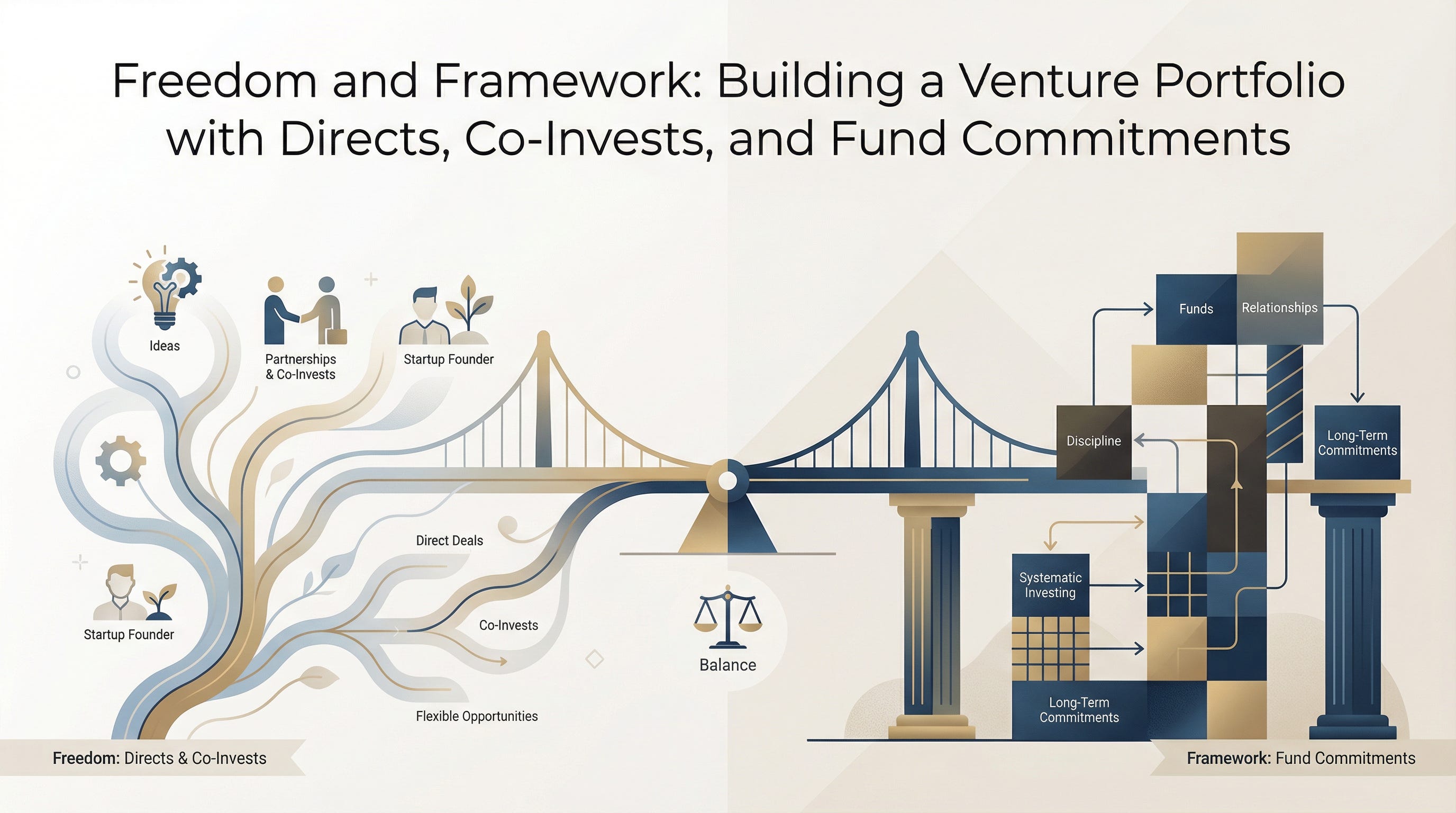
The strategic challenge for family offices is balancing the flexibility of direct investing with the discipline of a programmatic fund strategy. The goal isn’t to choose one or the other, it’s to use them together to build something durable.
The Framework: Funds as the Anchor
To build a venture portfolio that generates consistent returns, a “base load” of exposure is essential. This is where fund commitments play a critical role.
A fund portfolio acts as the “pace car.” By committing consistently to high-quality managers—whether established firms or emerging specialists—investors ensure they are in the market every single year. This solves the “vintage risk” problem. Since no one knows which year will produce the next generational outliers, having funds deploy capital ensures the family doesn’t miss out simply because they were focused on other operating businesses.
Funds also provide the discipline of professional due diligence and long-term relationship building that is hard to replicate with a small team. They are the “training log” of the strategy: consistent, repetitive, and foundational.
The Freedom: Directs and Co-Invests as the Alpha
If funds provide the beta (market exposure), directs and co-investments are where investors hunt for alpha—and express their values.
This is where judgment and specific convictions come into play. With the “safety net” of a fund portfolio, a family office can afford to be highly selective with direct checks. There is no pressure to do a deal just to put money to work.
Co-investments allow families to double down on winners emerging from their fund managers, effectively paying lower fees on their highest-conviction bets. They can back founders who align deeply with community values or specific industry expertise, offering patient capital that institutional funds cannot match. This flexibility allows the family office to be a “sniper” rather than a “shotgunner.”
The Balance: Governance as a Shield
The danger, of course, is allowing the “freedom” bucket to cannibalize the “framework” bucket. It is easy to get excited about a flashy direct deal and drain the liquidity meant for a capital call.
This is where governance—and a clear Investment Policy Statement (IPS)—becomes the most valuable tool.
An IPS shouldn’t be a constraint; it should be a decision-making filter. It defines the ratio—for example, allocating 60% of the venture budget to core funds and 40% to opportunistic directs.
When a deal arrives that doesn’t fit, the IPS allows for a “No” that protects relationships.
“The 2026 governance policy limits direct exposure to [Sector X].”
“The allocation for direct checks is fully committed this quarter, but an introduction to fund partners is possible.”
Governance protects the strategy from enthusiasm. It ensures that direct deals remain high-conviction “freedom” plays, rather than impulsive distractions.
Doing It Together
Balancing these two engines—funds and directs—is complex and requires constant calibration.
This highlights the value of building a community of aligned investors. The goal isn’t just to swap deal flow, but to help one another maintain that balance. Peers can share notes on fund managers to build the “Framework” and syndicate their best “Freedom” opportunities to trusted partners.
The opportunity is to stop choosing between being an LP and being a direct investor, and instead build portfolios that possess the discipline of a pension fund but the soul of a family office.
This is an educational post about GEX Ventures investments. It is for informational purposes only and may not be relied on as legal, tax, securities or investment advice and does not constitute an offer to buy or sell interest in any products offered by us or others. Email me at mk@gex.vc or leave a comment if you’d like to exchange ideas.
Great framework, Max. The "pace car" metaphor for fund commitments is very relatable - it's the base load that keeps you in the market while freeing you to be a sniper on directs.
One thing I'd add: the governance layer you describe (IPS as decision filter, not constraint) is where I believe most FOs break down in practice. The intent is there, but the tooling isn't..so the IPS lives in a PDF while deals arrive in email, and discipline erodes in real time.
I am a repeat founder based in SF and my cofounders and I are building something at Pegasus (getpegasus.ai) that sits right at this intersection - structured analysis for both fund decks and startup pitches, designed for exactly the investors you're describing.
I'd welcome an opportunity to chat and compare notes on how GEX thinks about systematizing the Framework/Freedom balance.