

It is reported that SpaceX raised roughly $12 billion in private markets across 31 rounds from more than 240 investors before it ever touched the public markets1. On 12 June 2026 it became the largest IPO in history.
A major part of the value in that outcome was created before the bell rang. It went to a small group of private investors who bought early, bought repeatedly, and did not sell for nearly two decades.
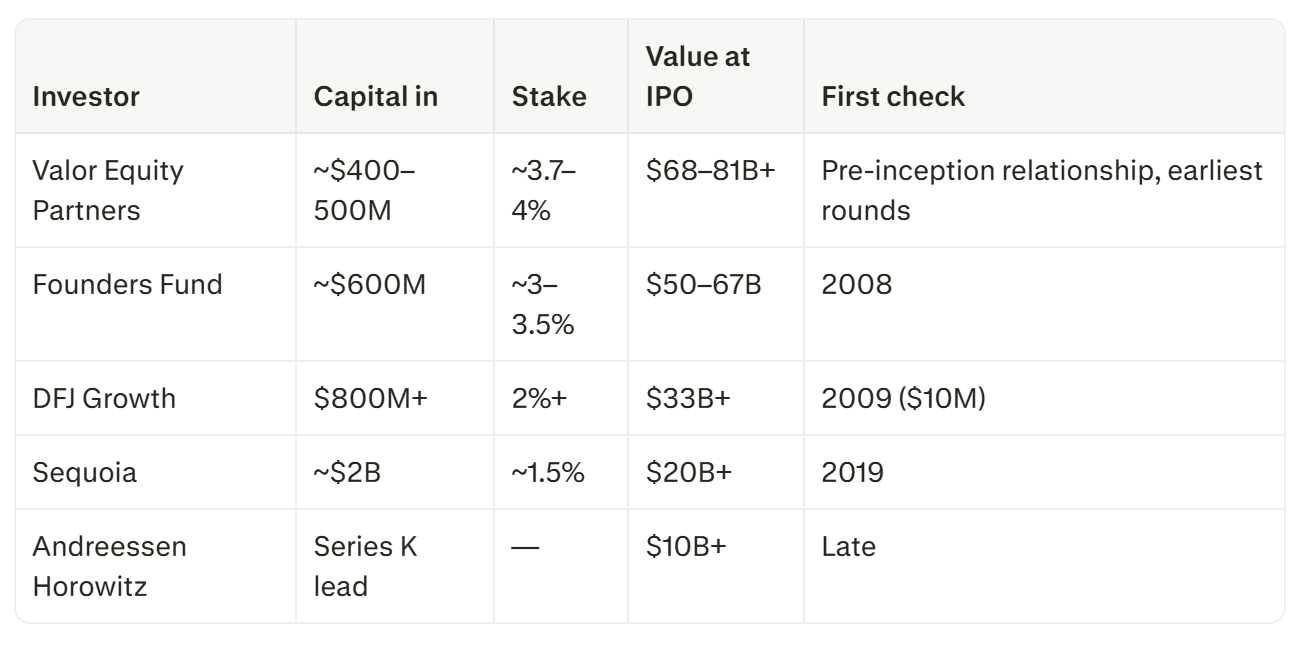
Plenty of firms saw SpaceX. The question that interests me is who was structurally able to hold, and the answer keeps pointing at one line in a fund document that barely gets enough attention:
GP commit.
The empirical case for taking GP commit seriously is better than most people assume. Brown and Volckmann2, working across a large cross-section of private funds, found that moving from a 2.2% commit (25th percentile) to 4.4% (75th percentile) is associated with roughly 150 basis points of IRR and about 0.1x of MOIC. More striking: the relationship keeps improving well past convention. Their estimated optimum for venture and growth equity sits around 11–13% of committed capital, against a dataset average of 3.5%.
Founders Fund at 27%
Here is the part I keep coming back to. Founders Fund I in 2005 was $50M, of which Thiel personally supplied $38M — a 76% GP commit. That is not a fund with a sponsor; that is a personal balance sheet that invited co-investors. Two decades and roughly $17B of AUM later, the pattern held rather than decayed.
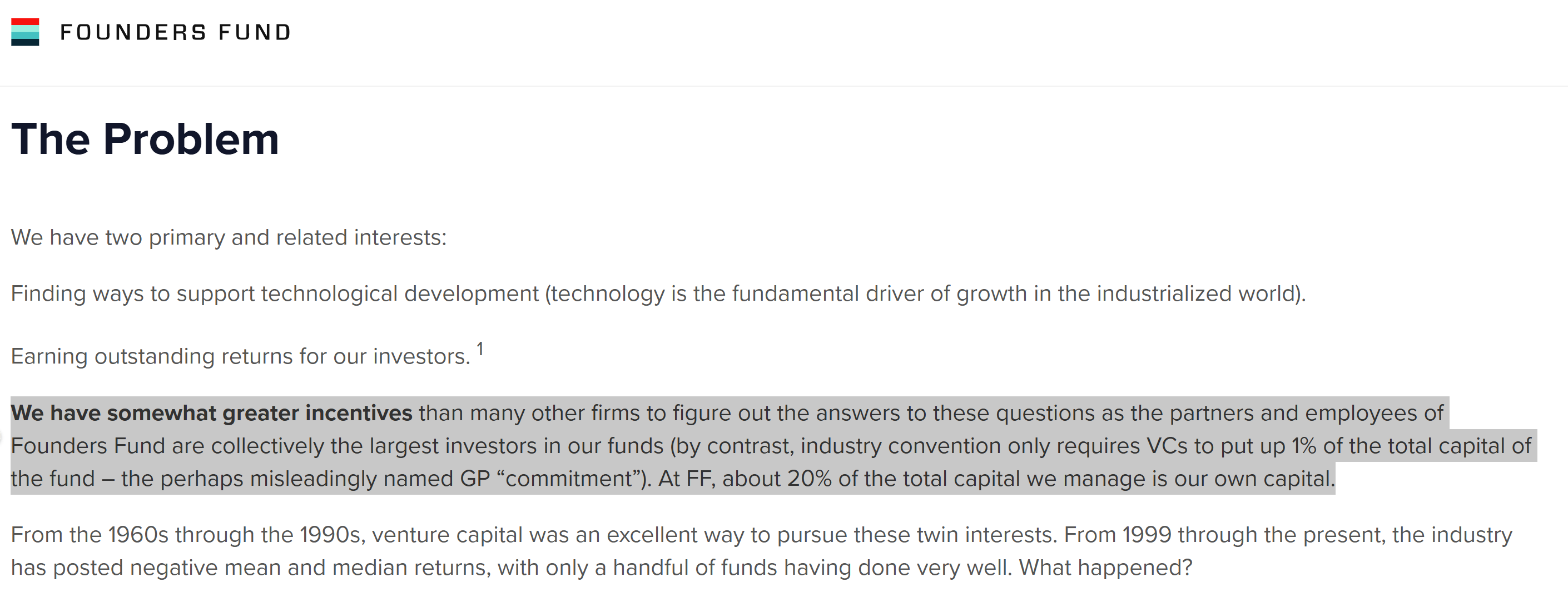
Now ask the practical question. What does an LP advisory committee conversation look like in 2016, when SpaceX is eight years in, illiquid, capital-hungry, and a secondary buyer is offering a very respectable mark? At a 1% commit, the GP’s personal exposure to that decision is rounding error against management fees; the rational move is to book the win, print the DPI, and go raise the next fund on it. At 27%, the GP is the largest single loser from selling early. Conviction stops being a personality trait and becomes an arithmetic outcome.
Founders Fund went so far as to identify GP commit as a structural advantage in its 2011 manifesto.
Meaningfulness over means
The failure mode in how we discuss this is that we index on the percentage instead of the commitment. A $50M commit on a $5B fund is 1% and enormous in absolute terms; it may also be a trivial fraction of the sponsor’s net worth. A $2M commit from an emerging manager whose entire liquid position is $3M is 2% of the fund and existential. The percentage tells you almost nothing on its own.
What matters is the significance of the commit to the individual GP — how much of their own outcome is genuinely at stake if the fund goes sideways. And significance is exactly what the standard diligence question fails to capture, because it asks for a number rather than a share of net worth.
Correlation, and Where It Stops
The answer is a qualified yes. Across large cross-sections of private funds, higher GP commitment is positively associated with performance on both IRR and MOIC. The relationship could become an inverted U rather than a straight line. More skin in the game improves alignment and dampens agency problems up to roughly 10–13% of committed capital; beyond that, risk aversion starts to work against returns. The uplift from moving out of the bottom quartile of commits is material, and the estimated optimum sits well above what most funds actually do, in both buyout and venture/growth.
This is an educational post about GEX Ventures investments. It is for informational purposes only and may not be relied on as legal, tax, securities or investment advice and does not constitute an offer to buy or sell interest in any products offered by us or others. Email me at mk@gex.vc or leave a comment if you’d like to exchange ideas.
https://keeptrack.space/deep-dive/who-owns-spacex
https://uncipc.com/publication/do-gp-commitments-matter/