

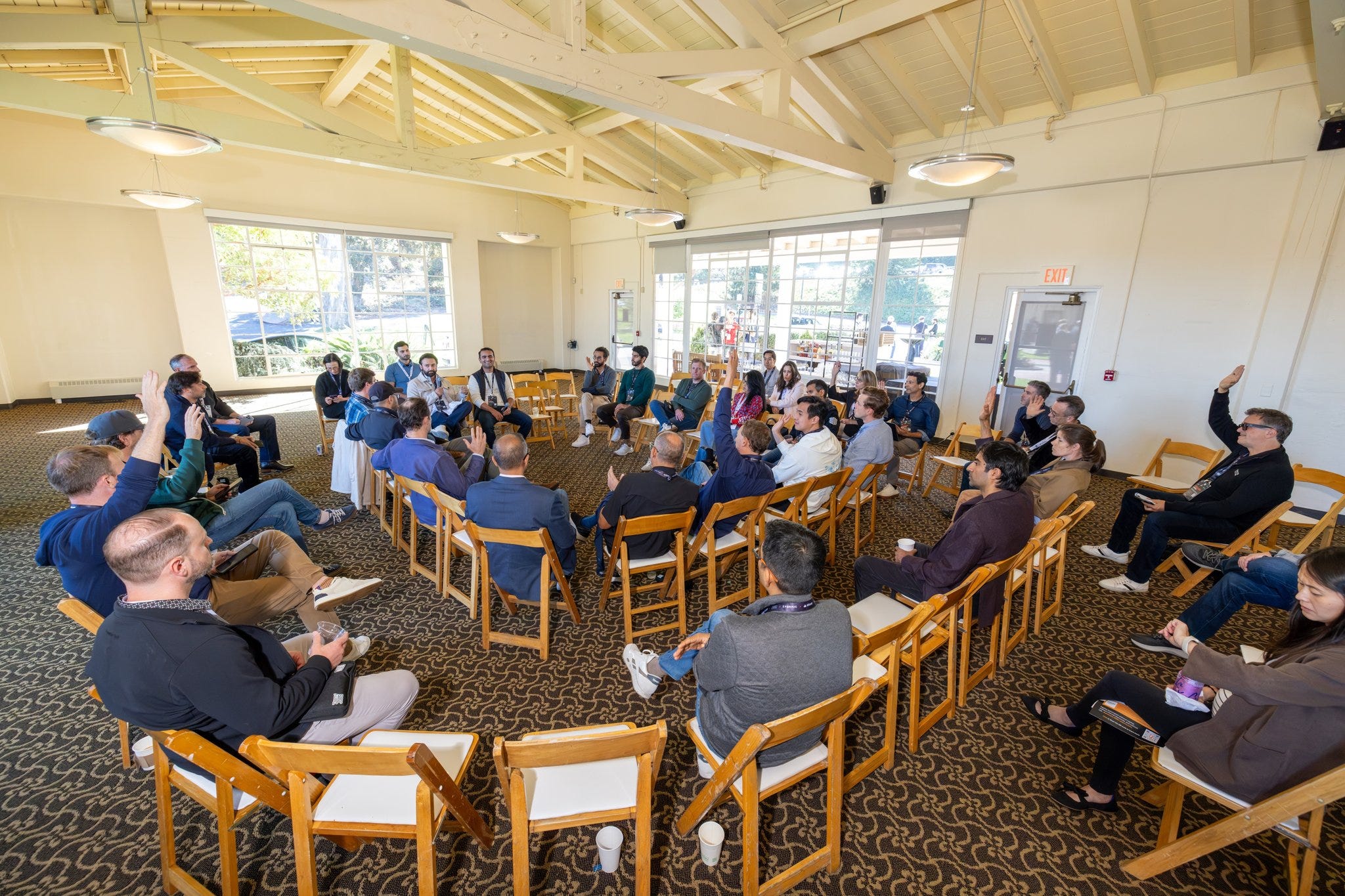
Late week, Vijay Chattha and I co-hosted a roundtable at the Golden Gate Club during Dirty Jobs 2026, sitting down with dozens of family offices and institutional allocators to tackle a single question: how do you underwrite Physical AI without getting too excited by demo videos?
Physics is the judge


In cognitive AI, the definition of performance is negotiable. If an enterprise chatbot generates a legal memorandum or drafts marketing copy, five different attorneys or CMOs will offer five different grades on whether the output is acceptable.
The physical world offers no such cover. Physical AI is embodied intelligence where the search space is bounded by physics, meaning reality serves as the ultimate, unyielding referee.
A self-driving vehicle either clears the intersection safely or it malfunctions. An agricultural robot either weeds the row without damaging crops or not. A warehouse manipulator either picks and packs at human parity speed or the fulfillment line shuts down.
Underwriting Paramters
Allocators cannot underwrite Physical AI like SaaS. You are not underwriting abstract code in isolation; you are underwriting deployment discipline, supply chain dynamics, and time between human interventions.
To cut through narrative creep before wiring capital into physical automation platforms, we discussed a few screening steps:
Verification: Insist on performance benchmarks where failure modes are physically measurable rather than qualitatively described.
Intervention: Evaluate autonomy based on human intervention rates per defined cycles under real-world dirt and latency, not lab demos.
Hardware: Determine whether the defensibility lives in custom hardware or in proprietary multimodal policies trained on unique field data. Hardware is rarely the core of innovation in and of itself.
Timeline: Model capital requirements with adequate runway for physical pilot cycles, recognizing long engineering and deployment cycles. Foundational shifts in deep tech do not run on app-like product cycles. Having studied physics before entering finance, and watching my family build in telecoms, I know genuine technological transitions demand paradigm shifts which take time.
Deal Structure
For family offices and LPs, the above underwriting parameters sit on top of sourcing and structuring the investment itself, which has become dizzyingly noisy in the world of SPVs and multi-layer entities. It goes without saying: never invest in anything where there is doubt about a clean and clear structure, and take zero counterparty risk.
Fast-moving momentum capital often lacks the patience required to verify and underwrite all of these together AND survive industrial pilot programs. When hardware iterations hit snags, crossover and momentum-driven capital retreats.
That structural patience is the exact competitive advantage of family capital. When family offices combine long investment horizons with rigorous, ground-level verification, they are ideally positioned to back the teams rebuilding modern industry.
If you are an allocator building an enduring physical AI portfolio, focus on the physics before you focus on the AI.
UPDATE: I wrote the final draft while waiting for my flight at SFO and ordered a coffee from a robotics café. It got my order wrong and spilled the drink all over the cup. I saw no verification steps when that happened and it should’ve been smarter. That’s not really Physical AI, but an adjacent case of a robotic, automated coffee shop.
This is an educational post about GEX Ventures investments. It is for informational purposes only and may not be relied on as legal, tax, securities or investment advice and does not constitute an offer to buy or sell interest in any products offered by us or others. Email me at mk@gex.vc or leave a comment if you’d like to exchange ideas.